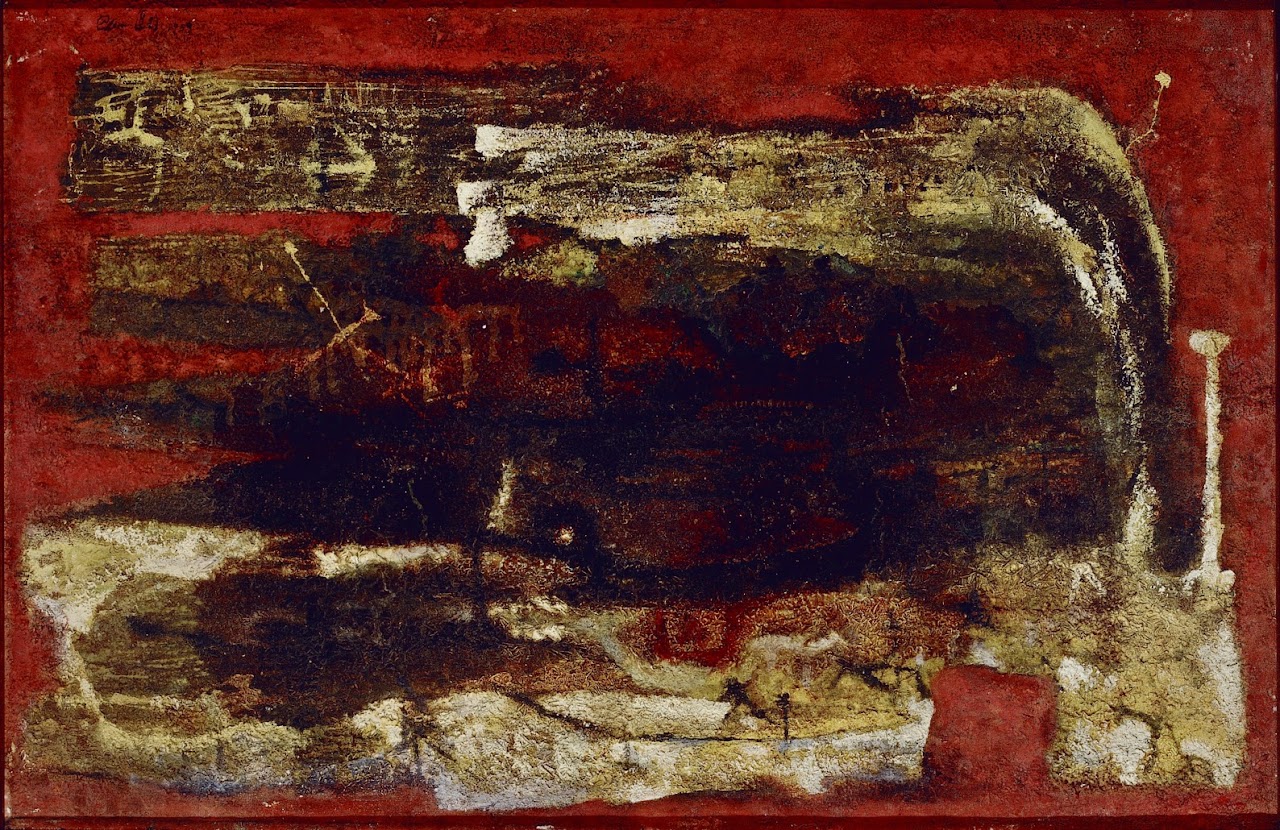
Vers la vie (Collection No. 27323), housed in the National Museum of History, is a painting created with broad, layered applications of black, white, and yellow pigments over a red background. Through large, expressive brushstrokes, the artist abstractly conveys inner thoughts and intentions. The work exudes a bold and unrestrained atmosphere, while still retaining a subtle and refined spiritual depth.
This painting was created by Mr. Chen Tao-Ming, one of the founding members of the Ton Fan Art Group and recognized as Taiwan's first abstract painter. Born in Jinan, Shandong Province in 1931, Chen entered Taipei Normal College at the age of 18. Dissatisfied with the rigid academic system, he left at 21 to study under Li Chun-Shan, regarded as the father of modern art in Taiwan, receiving individualized, mentorship-based instruction. In 1957, together with fellow students including Ouyang Wenyuan, Huo Kang, Hsiao Chin, Li Yuan-Chia, Wu Hao, Hsia Yang, and Hsiao Ming-Hsien, he co-founded the Ton Fan Art Group. The members were collectively known in the art world as the Eight Bandits.
Chen participated in the Sao Paulo Biennial in Brazil in 1959 and 1965, and in 1962 he was awarded the Silver Medal at the 2nd Hong Kong International Painting Salon. After the dissolution of the Ton Fan Art Group in 1971, its members pursued their individual artistic paths.
From the 1980s onward, Chen began working with water-based media such as acrylic and watercolor. By skillfully utilizing the fluidity and diffusion of these materials, his works became brighter and warmer in tone, while also emphasizing the dynamic quality of line and a freer expression of time and space. Reflecting on his artistic philosophy, Chen once said:
When I paint, I feel joy - it's like a game. I often feel as though I'm playfully engaging with the world. Unrestricted, living freely - that is my belief, my guiding principle.
Vers la vie was acquired by the National Museum of History in 1968.