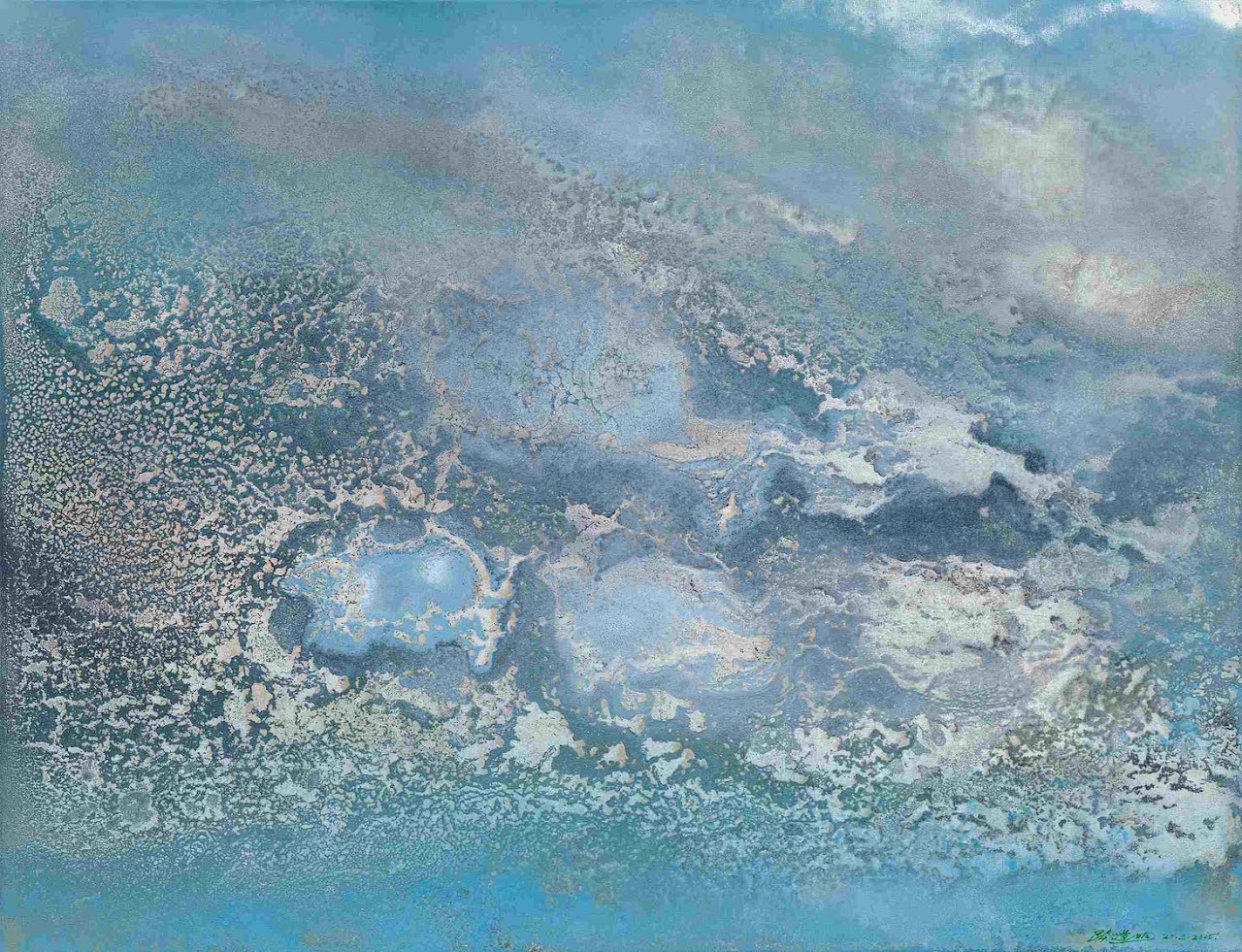
Tao-Ming Chen (1931-2017), an abstract artist best known as Tommy Chen, is a representative Taiwanese art figure on two major counts. Historically, his career paralleled—and helped launch—the country’s postwar modernism; formally, his works exemplify what might be called “hyper-subjective abstraction,” a style closely associated with Taiwan’s midcentury cultural character. Both contributions are based on the artist’s deft synthesis of Eastern and Western aesthetic traditions, skills, and temperaments.
Chen was born in Jinan, Shandong Province, in northwestern China during an extremely volatile period: the 22-year Chinese Civil War (1927-1949), which was exacerbated in mid-conflict by the Japanese occupation of Manchuria (1931) and the Second Sino-Japanese War
(1937-1945). Because Chen’s father was a government official, the family was displaced several times: first southwest to Chongqing (for three months) and Chengdu (two years), then back northwest to Lanzhou (10 years). In 1949, when Mao Zedong and his National Liberation Army triumphed throughout the mainland, Nationalist president-general Chiang Kai-Shek and his followers to depart for Taiwan, where they established an alternative government. The exiled Chen family numbered among its five children the 18-year-old Tommy, who enrolled at the Taipei University of Education.
Up to that point, the young man’s most formative artistic influence had been the traditional ink painter Pei Jianzhong, with whom he studied for decade in Lanzhou, beginning at the age of eight. From grinding ink powder to sketching landscapes to visiting the Buddhist-art caves of Dunhuang, Chen’s apprenticeship instilled in him a deep respect for Chinese cultural heritage and artistic principles. Yet when he began college, Chen—whose life had been
disrupted by two highly mechanized wars and a Marxist ideology spawned in Europe—chose to major in Western painting.
Why this seemingly counter-intuitive choice? Like many Asian artists before and since, Chen was deeply enamored of the promise of freedom, social as well as artistic, that the Western avant-garde vividly modeled and proclaimed. Japan, which ruled Taiwan from 1895 to
1945, had established no art academies on the island: would-be Taiwanese artists were expected to undergo professional training in Japan. After 1945, by contrast, victorious American military and business personnel brought a wave of Western consumerism, pop-cultural fads,
and (for the more serious-minded) global artistic diversity. Soon Taiwan had burgeoning art departments and schools of its own.
Thus Chen, still a teenager, stepped into the middle of a three-way struggle for the soul of Asian art. Ever since the 16 th century, European and American powers—through wars of conquest, colonialism, religious conversion, and trade—had spread throughout the East a new
version of history that equated modernism with Western social mores and, soon, industrialized life. This imposition fostered deep offense in Japan, no doubt contributing to that country’s vengeful 20 th -century imperialism. In China, scarred by its own “century of humiliations”
inflicted by foreign nations, the initial 20 th -century standoff was between loyalty to the great dynastic past and all its trappings—Confucianism, Daoism, Buddhism, ancestor veneration, court art, literati painting, etc.—or an embrace of “progressive” social and artistic change.
China’s New Culture and May Fourth movements of the 1910s and ’20s, pitted forward-looking activists against the defenders of the historical status quo, in fine art as well as in every facet of daily life. Even before Chen’s birth, artists like Xu Beihong, Chang Shuhong, Yan Wenliang, Chang Yu (Sanyu), Pan Yuliang, Lin Fengmian, and Xie Touba were going abroad to learn Western oil-painting techniques—Renaissance-based devices such as linear perspective, chiaroscuro, and sfumato, as well as radical contemporary experiments with materials, techniques, and artistic concepts. Many of these artists brought an altered worldview back to the homeland, where their novel methods were adopted by others—notably Liu Haisu, who in
1912 founded the Shanghai Academy of Fine Arts, a culturally eclectic school that was the first in China to employ live nude models for Western-style figure studies.
Understandably, the young Chen wished to avail himself of both these major geo-cultural options—Eastern and Western—hoping to blend them synergistically. But that would entail a second choice. Modern Western painting had already split into two often antagonistic
camps: the figurative and the nonrepresentational. By 1949, due in part to its association with the false heroics of the Nazi, Fascist, and Communist regimes, figuration was politically stigmatized for many avant-garde artists. After flirting briefly with Constructivism and other
“advanced” art movements, Soviet Russia, putatively home to the world’s most progressive socioeconomic doctrine, adopted one the world’s most conservative aesthetics—that of the French Academy, whose formal rigidity and elevated didacticism had been assailed by modern artists ever since the mid 19 th century.
The commissars’ move was blatantly pragmatic. Noble Academic ideals could easily be converted to political propaganda. Under the leadership of the Party, figurative art no longer imparted Biblical wisdom or the moral lessons of Classical civilization but, instead, charged the masses with an urgent and all-encompassing need to work together for a utopian future. In China, Mao Zedong used his 1942 Talks at the Yan’an Conference on Art and Literature to espouse an “art for the people”—meaning, in practical terms, an art for indoctrinating the people. Socialist Realism—with its shiny-faced workers, peasants, and soldiers striving earnestly, often joyfully, for collective spiritual transport and an imminent material abundance—would become the only officially sanctioned art style in the People’s Republic of China until the late 1970s. Chen’s choice, his repudiation of all programmatic art, was definitive: he eschewed representation altogether. Neither the quaint faux-folk art practiced by some Taiwanese artists, nor Asia’s second- and third-wave Impressionism, nor the Mainland’s sentimental “academic naturalism”—prone to depicting noble peasants, exotic Indigenous peoples, and fair young
maidens in doorways (an eroticized vision of nature on the verge of an economically “developed” future)—diverted the young artist. Instead he became a student of Li Chun-Shan, now considered the “father of Taiwanese modernism.”
Li, who had studied at Liu Haisu’s pioneering Shanghai Academy of Fine Arts, was one of the founders of the Storm Society, the first group of artists in China to advocate for modern painting. Traveling to Japan in 1932, he attended the Tokyo Institute of Avant-Garde Fine Arts and was deeply influenced by the unorthodox teaching of Léonard Tsuguharu Foujita, who had spent years as a well-known bohemian figure in Paris. (Ironically, Japan—"closed” for two and a half centuries and forced open in 1854 literally at the point of a gun, i.e., the cannons on American Commodore Matthew C. Perry’s ten warships—became an active outpost of modernist culture in Asia, even as countervailing nationalistic pressures mounted within the
country.) In 1949, Li came to Taiwan and began offering instruction to private students at his Antung Street Studio. Defying convention, he steered his students away from the venerable practice of endlessly copying ancient Chinese masters, advising them instead to go out into the streets of Taipei and take inspiration from the life they saw there. On Sundays, he held outdoor group sketching sessions in a teahouse. Over the years, his own work became increasingly gestural and, eventually, nonrepresentational.
Galvanized by Li’s cosmopolitan openness, Chen began producing works that combine brushstrokes reminiscent of ancient oracle-bone script with the angularity of Analytic Cubism. Together with Wu Hao, Hsiao Chin, Hsia Yan, Li Yuan-chia, Hsiao Ming-hsien, Ouyang Wen-yuan, and Ho Kan—all fellow students of Li Chun-shan—he founded the Ton Fan Group in 1956. Chen and his colleagues, like their rivals in the Fifth Moon Group, sought to modernize Taiwanese art without entirely jettisoning their Chinese cultural heritage. (Their name translates in English as the Eastern Painting Group.) This respectful duality distinguishes Taiwan’s progressives from the PRC’s Maoist radicals who, during the Cultural Revolution of 1966-76, tried to obliterate the Four Olds—old ideas, old culture, old customs, old habits—by self-righteously destroying antique buildings, artworks, and artifacts. Indeed, the Ton Fan Group’s manifesto, “Our Declaration,” advocates a cultural fusion in which “the infinite artistic treasures of China would have a place in today’s world.”
To some extent, this East-West dialogue was already well underway—not only through Asian adoption of Euro-American modernism, but also through the impact of Japanese prints on Impressionism and the debt that Abstract Expressionism owed to Chinese literati painting and calligraphy, as well as the critical esteem that living figures like Zao Wou-Ki and Chang Dai-chien were winning in Europe and the United States. Nevertheless, Taiwan’s president—who had already commandeered 700,000 examples of China’s “infinite artistic treasures”—deeply distrusted Western influences. His attitude was not to be taken lightly: martial law prevailed from 1949 to 1987, and the country did not attain true democracy until 1996, two decades after Chiang Kai-shek’s death. During the 15 years of the Ton Fan Group’s existence, the members, far from being officially endorsed, were deemed cultural mavericks—an image that, in classic avant-garde fashion, they deliberately cultivated. Their defiance of convention was precisely their artistic purpose, which prompted United Daily News reporter Ho Fan to dub them the “Eight Highwaymen of the East.”
The group’s first show was held in 1957, not in a designated cultural space but in the Shin Sheng Daily News Building. From the start, the members chose to intermingle with artists and works from abroad. The “Ton Fan Group Inaugural Painting Exhibition—Chinese and Spanish Modern Artists Joint Exhibition” took place simultaneously in Taipei and at the Galería Jardín in Barcelona. Fourteen more exhibitions followed, many of them muti-cultural, including outings in Italy, Germany, and the United States, before the group—whose roster had become somewhat fluid—disbanded in 1971.
Chen was one of Ton Fan’s most formally experimental members, and fellow artist Hsiao Chin went so far as to call him Taiwan’s first fully abstract painter. But that designation, perhaps more honorific than technically precise, is only the beginning of the story. For by the mid-20th century, several varieties of painterly abstraction were on offer, from linear and schematic (aka hard-edged or geometric) to patterned and Color Field to expressively gestural. Abstraction had begun, at the turn of the 20 th century, as a means for marginalized artists like Georgiana Houghton, Austin Osmond Spare, Emma Kunz, and Hilma af Klint to “communicate” with spiritual beings ranging from household ghosts to God Almighty. These early practitioners
considered themselves literal messengers, obeying the dictates of higher powers, often personified, and serving as a living medium between the earthly realm and the eternal. Slightly later, and in a more “spiritual” (versus “spiritualist”) manner, artists like Kazimir Malevich, Wassily Kandinsky, Frantisek Kupka, and Piet Mondrian spoke of conveying cosmic “forces” or a timeless impersonal “presence.” Later still, Robert and Sonia Delaunay treated
abstraction as an index of the dynamism of contemporary life, while Josef Albers restricted his investigations to the mechanics of human visual perception, thereby opening the way for the Op Art of Victor Vasarely, Bridget Riley, Richard Anuszkiewicz, and others. This progressive secularization, from divine converse to inner psychological probe to pure optical design, was memorably exemplified in midcentury by the Abstract Expressionists, who endowed their canvases with palpable energy and a brooding sense of the Sublime.
It is to these artists that Chen apparently felt most akin, probably for three major reasons. First, abstraction could provide him a mental escape from the world of wars into which he was born. Second, the style’s reliance on formal configurations and gestures recalled the Chinese ink-and-brush methodology of his youth. And third, its manner of production—a lone artist with a dream in his heart and a few simple tools in his hands—resonated with the entrepreneurial ethos of the postwar Taiwanese Economic Miracle. In his 1962 polemic “Art as Art,” the abstract painter Ad Reinhardt declared: “art is art-as-art and everything else is everything else.” That impulse toward self-purification, exalting abstraction as a realm apart, was not unlike the motive that once drove monks and sages to sequester themselves, or ancient literati painters to withdraw from commerce, government, and court intrigue in order to pursue private pleasures and ever greater aesthetic refinement. Moreover, the art those literati produced often featured spontaneity, fluidity, and speed, qualities allegedly reflecting the flow of qi, a universal life-force. The old Chinese concern with the essence of each pictorial subject rather than its literal appearance can be readily tied to British critic Clive Bell’s modernist notion of “significant form,” itself a distant echo of Plato’s eternal Ideas.
Yet the mundane and the political have a way of intruding on even the most transcendent domains. Despite the the president’s tough autocratic rule, Taiwan in the 1960s (when Ton Fan was at its most active and Chen twice participated in the São Paulo Bienal) was widely seen—and saw itself—as a bulwark of modernism, capitalism, and (relative) freedom in Asia, especially in contrast to mainland China. Such, at least, was the rationale that prompted the United States and other Western governments to treat Taiwan as a proxy state during the Cold War. Under that scenario, an abstract painter embodied individual liberty and verve. Each work was a pursuit of truth, yes, but also and an instance of private entrepreneurship made
visible—in stark contrast to Socialist Realist enslavement to a blatant falsehood. As an abstractionist, Chen was theoretically a free individual in a free society, able to pursue his own existential project to the best of his abilities, with whatever means he could afford. Such autonomy has an economic cost, of course, as every struggling artist knows. Eventually, Chen was compelled to set painting aside for a period of roughly 15 years, from the
mid-1960s to 1978, while he developed a fashion business that would comfortably sustain his family. His retreat from art was never absolute, however. Designing for the firm kept Chen thinking about color, composition, and texture; and in 1976, one of his sisters—herself an artist living in the U.S.—sent him samples of acrylic paint. The medium’s fast-drying quality opened up even more spontaneous aesthetic possibilities. Chen soon revived his art practice, plunging ever deeper into the painterly issues that had previously enthralled him.
Decades earlier, Chen’s mentor, Li Chun-shan, had introduced him to Surrealism and its links to the Freudian unconscious. Now, like the Abstract Expressionist painters he admired, Chen opted to bypass signs and symbols for a direct channeling of psychic forces. This was, once again, an extension, not a rejection, of his cultural heritage. Many traditional Chinese artists aimed to convey their own contemplative act and thereby elicit a corresponding
response from the viewer. Their work is, in effect, the mind’s visually encoded record of its own processes. Those lonely mountain cataracts, those boats on a meandering river, those distant temples, all set among great stretches of emptiness and time, are emblems of the human condition, to be sure, but also markers of a particular artist’s way of feeling and thinking about that condition. The familiarity of such markers, their use and reuse over centuries, reminds us that all individual expression, like the individual apprehension that subtends it, is culturally structured. We speak in the language of the tribe, or fall silent. Similarly, in the West, one could say (with unusual concision but without exaggeration) that in the 18th century Kant argued we can “know” the universe only through the filters of our innate sensual and mental modalities—and the result, in the 20 th century, was abstract art: an attempt to evoke those modalities in and of themselves, free of distracting subject matter.
Chen thus was able to regard his painting as a personal psychological arena, an interior territory where the tumult is psychological, formal, and chromatic—but not literally bloody as in the outside world. The beauty and equanimity of Chen’s compositions bespeak his grounding in the Chinese tradition of cosmic yin-yang balance, manifest in an art of pervasive harmony and calm. Yet, equally, the constant change and complexity of his work—the renewal of questioning from canvas to canvas, the visual churn within any one composition—signal a countervailing mindset. Consider, for example, how Chen’s forms seem to loom up and melt way; how his layering of pigment connotes the interaction of perceptions and feelings; how the pleasing
colors sometimes complement and sometimes contrast, like characters in an optical drama. This inherent flux shows that Chen was forever contending with the typically Western dilemma of endless psychic and social turmoil, in which the elements of conflict are not denied or expunged but temporarily held in “dynamic tension” (the term that bodybuilder Charles Atlas used for his system of pitting one set of muscles against another, to eventually increase the strength of both).
The Abstract Expressionists were always looking for the moment when “it” happened, when the painting was “resolved,” through what the mystical William Blake once called a “reconciliation of contraries.” Chen, it appears, also strove for those transient moments of surcease, when differences, though fully acknowledged, are beautifully transcended—at least in an abstract image, if not in the artist’s ever-restless soul.
About the author :
Richard Vine is a former managing editor of Art in America magazine and the author of New China, New Art.